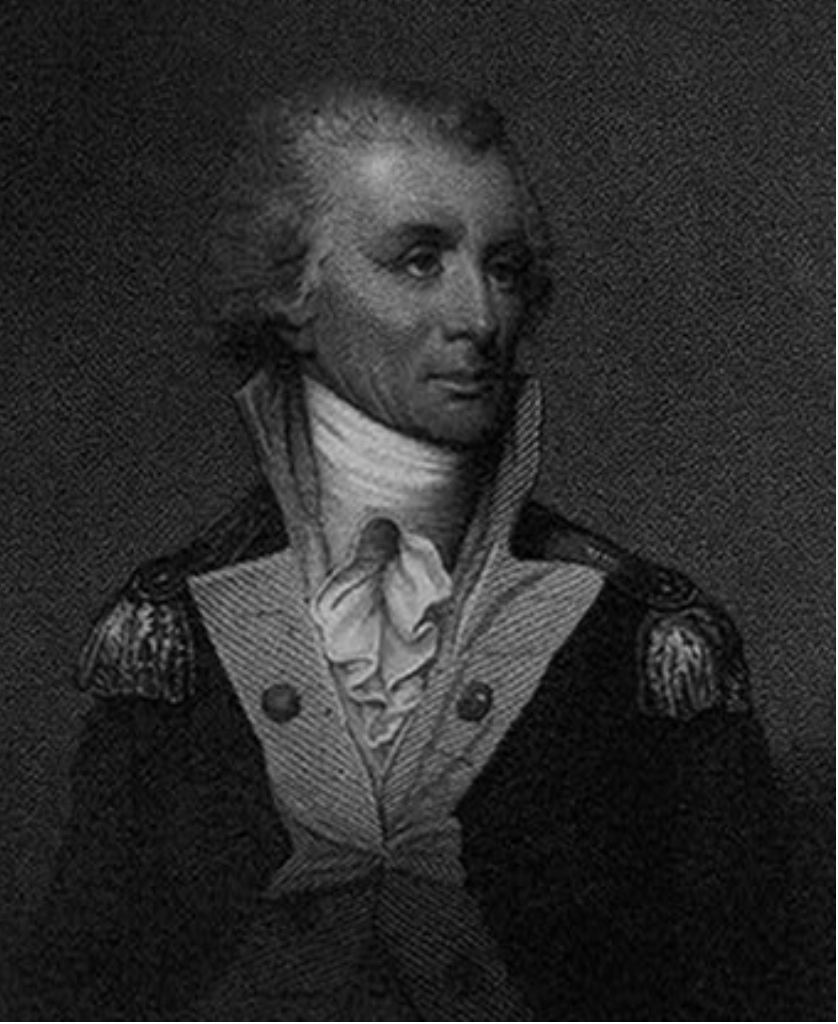
By the summer of 1780, the British had done something to Thomas Sumter that they would come to regret: they had made him angry. In May, after the fall of Charleston and the collapse of organized Continental resistance in South Carolina, Banastre Tarleton's dragoons rode to Sumter's plantation on the Catawba River and burned it to the ground. His wife was left on the road. His slaves were taken. Everything he had built was ash.
Sumter had been out of the war. He was forty-six years old, a veteran of the French and Indian War and earlier campaigns against the Cherokee, but he had sat out the opening years of the Revolution on his plantation. The British made the decision for him. Within weeks of watching his home burn, he had raised a militia force and was back in the field — this time with no intention of stopping.
Thomas Sumter was born in 1734 in Hanover County, Virginia — the same county that produced Patrick Henry — the son of a Welsh immigrant miller. He had little formal education but an abundance of physical courage and an instinct for leadership that showed itself early. He served in the Virginia militia during the French and Indian War, was captured by Cherokee warriors during Pontiac's Rebellion, and managed to escape — a story that became something of a legend in the backcountry. He eventually settled in South Carolina, married a wealthy widow, and became a man of property and some standing. He served in the colonial legislature. He was not looking for a fight.
But after the burning, he fought with a ferocity that earned him his nickname. The Gamecock. It was not a gentle comparison — gamecocks fight to the death, refuse to retreat, and keep coming no matter how badly they are hurt. His men adored him and feared him in equal measure. He was aggressive to the point of recklessness, demanding, and indifferent to hardship. He expected the same from the men who rode with him.
Through the summer and fall of 1780, Sumter's militia struck British posts and Loyalist gatherings across the South Carolina backcountry in a campaign that kept the British off-balance and prevented them from consolidating their hold on the interior. He attacked Rocky Mount on August 1st. Five days later, he struck Hanging Rock, inflicting heavy casualties on a Loyalist force before his men — having discovered the garrison's rum supply — became too disorganized to finish the job. These were not the clean victories of formal warfare. They were grinding, costly, and often inconclusive. But they were enough.
His most dangerous moment came on November 20th, 1780, at Blackstock's Farm on the Tyger River. Tarleton, Britain's most feared cavalry commander, caught up with Sumter's force and attacked. The battle was sharp and close. Sumter was struck by multiple buckshot — one ball lodged near his spine and would remain there for the rest of his life — and had to be carried from the field wrapped in a raw hide. His men held. Tarleton withdrew. It was counted a Patriot victory.
Sumter recovered. He always recovered. He returned to command in the new year and continued fighting until the British abandoned the interior of South Carolina in 1781. He was difficult to work with — Nathanael Greene, the Continental commander, found him infuriating, independent, and impossible to coordinate — but there was no question that Sumter's campaign had kept resistance alive in the backcountry during the darkest months of the war in the South.
After the war, Thomas Sumter entered politics. He served in the United States House of Representatives and the Senate. He lived to be ninety-seven years old — the last surviving general officer of the American Revolution — dying in 1832 on the same land where, fifty years earlier, the British had tried to break him.
Fort Sumter, the harbor fortification in Charleston whose bombardment opened the Civil War in 1861, bears his name. He never saw it. But he would have understood the instinct that built it — the stubborn, expensive refusal to let the Carolina coast be held by an outside power. Some things, in South Carolina, do not change.